

Did you turn on your air conditioner and get a strange smell like dirty gym socks, mildew, or a damp locker room?
If yes, chances are you are dealing with dirty sock syndrome.
You see, when you get a weird smell from your HVAC system, you might assume there’s mold in air ducts. Also, you can think there’s something wrong with the AC’s mechanics.
But in many cases, this is caused by something HVAC professionals call dirty socks syndrome.
This is common not just in New Jersey but across the country. And it is usually fixable.
However, if you ignore it for too long, the odor can keep returning every time your HVAC system runs, making your home smell unpleasant.
In this blog, I will explain everything about this syndrome.
Read on to know:
- What dirty sock syndrome is
- Why your air conditioner smells like dirty socks
- What causes dirty socks syndrome HVAC problems
- Whether dirty socks syndrome is dangerous
- How to get rid of dirty socks syndrome
- And when you should call a professional
Table of Contents
Key takeaways
- Dirty sock syndrome is a musty odor that comes from an HVAC system
- It is usually caused by mold, mildew, bacteria, or biofilm buildup on the evaporator coil
- Heat pumps and air conditioners are both susceptible to dirty socks syndrome
- The smell is often strongest during spring and fall
- Dirty socks syndrome does affect indoor air quality
- It is usually not considered a major health hazard but can irritate sensitive individuals
- Professional evaporator coil cleaning is often the most effective solution
- Regular HVAC maintenance can help prevent the problem from returning
What is dirty sock syndrome?
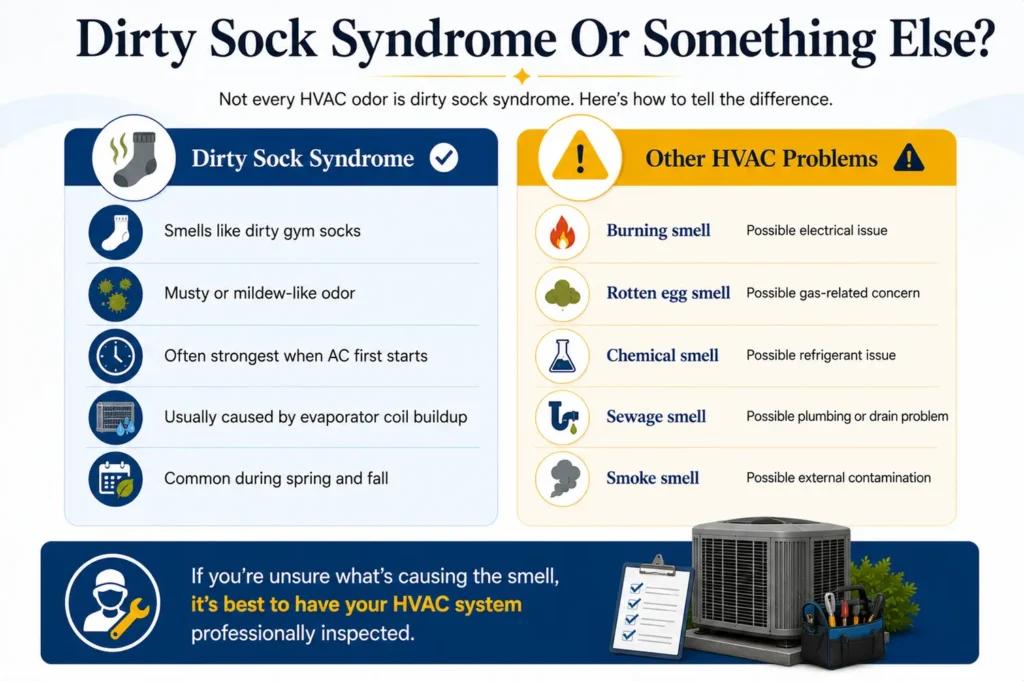
For starters, dirty sock syndrome is a term used to describe a foul, musty odor that comes from an HVAC system when it turns on. And as the name suggests, the smell is compared to dirty socks, sweaty gym clothes, mildew, damp towels, or a musty basement.
People assume the smell is coming from their air ducts. But in reality, the odor is being created inside the HVAC system itself.
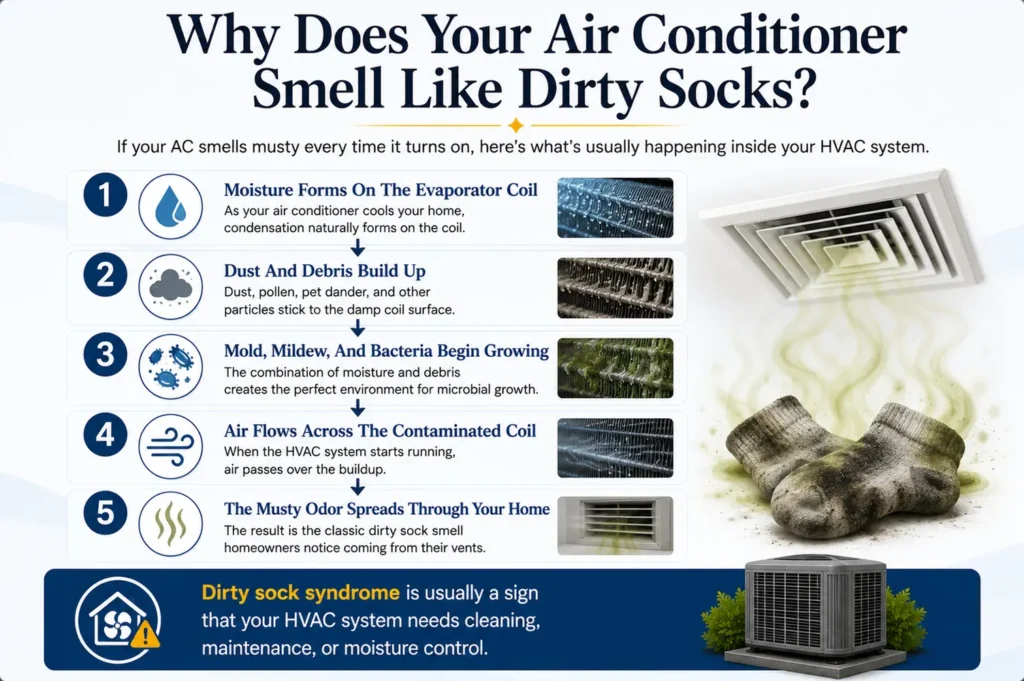
You see, over time, moisture can collect on certain HVAC components. And when that moisture combines with dust, dirt, and organic particles, it creates an environment where mold, mildew, bacteria, and biofilm can grow.
Now, as air passes over these contaminated surfaces, it carries the unpleasant smell throughout your home. This is why you notice the odor almost immediately after the system starts running.
What causes dirty sock syndrome in HVAC systems?

Now that you know what HVAC dirty sock syndrome is, let’s take a closer look at what actually causes it.
To begin with, there is no single reason why HVAC smells musty. There are several factors that work together to create the perfect environment for odor-producing microbial growth.
Overall, here are the most common reasons why your air conditioner smells like mildew:
1. Dirty evaporator coils
The evaporator coil is by far the most common reason why your AC smells like dirty socks.
This coil stays cool whenever your air conditioner is running. And as warm indoor air passes over it, moisture naturally condenses on its surface.
Over time, dirt, dust, pollen, and other airborne particles stick to the coil as well. And when moisture and debris combine, mold, mildew, bacteria, and biofilm can begin growing.
Eventually, this buildup starts producing the musty odor homeowners associate with dirty socks syndrome.
2. Excess moisture inside the HVAC system
Moisture is one of the biggest contributors to microbial growth.
You see, if water is not draining properly from your HVAC system or if your AC is leaking water, damp conditions can persist long after the cooling cycle ends.
And whenever moisture remains inside the system, mold and bacteria have more opportunities to grow.
That’s why drainage issues often result in recurring dirty socks syndrome AC problems.


Contact us to improve your indoor air
quality with our expert cleaning services in NJ.
3. Mold and mildew growth
Many homeowners immediately think of mold when they smell a musty HVAC odor.
And sometimes they’re right. Mold and mildew can grow on evaporator coils, insulation, drain pans, and other damp HVAC components.
As these microorganisms grow, they release compounds that create unpleasant smells. This is one reason why an air conditioner smells like mildew in some homes.
4. Biofilm buildup
Biofilm is a thin layer of microorganisms that sticks to surfaces exposed to moisture. You can think of it like a slimy coating that develops over time.
Biofilm can trap bacteria, mold spores, dust, and moisture all in one place. And as it grows inside your AC, it can become a major source of HVAC odors.
In fact, many HVAC technicians consider biofilm buildup one of the primary causes of persistent dirty socks syndrome.
5. Poor HVAC maintenance
When HVAC systems go years without professional cleaning or inspection, dirt and moisture can accumulate throughout the equipment.
You might already be seeing signs of clogged air ducts and dusty vent openings, and this is eventually why HVAC smells musty.
That’s why routine HVAC maintenance is one of the most effective ways to prevent dirty socks syndrome from developing in the first place.
In short, here’s what causes dirty sock syndrome:
| Cause | Impact |
| Dirty evaporator coil | Traps moisture and debris |
| Excess moisture | Encourages microbial growth |
| Mold and mildew | Creates musty odors |
| Biofilm buildup | Produces persistent smells |
| Lack of maintenance | Allows contamination to accumulate |
How to get rid of dirty sock syndrome from your HVAC?

Now that you know why your air conditioner smells like mildew, you might be wondering how to fix it.
The answer depends on what’s causing the odor and how severe the buildup has become.
In some cases, simple maintenance may help reduce the smell. However, if microbial growth has already developed on HVAC components, professional HVAC cleaning is the most effective solution.
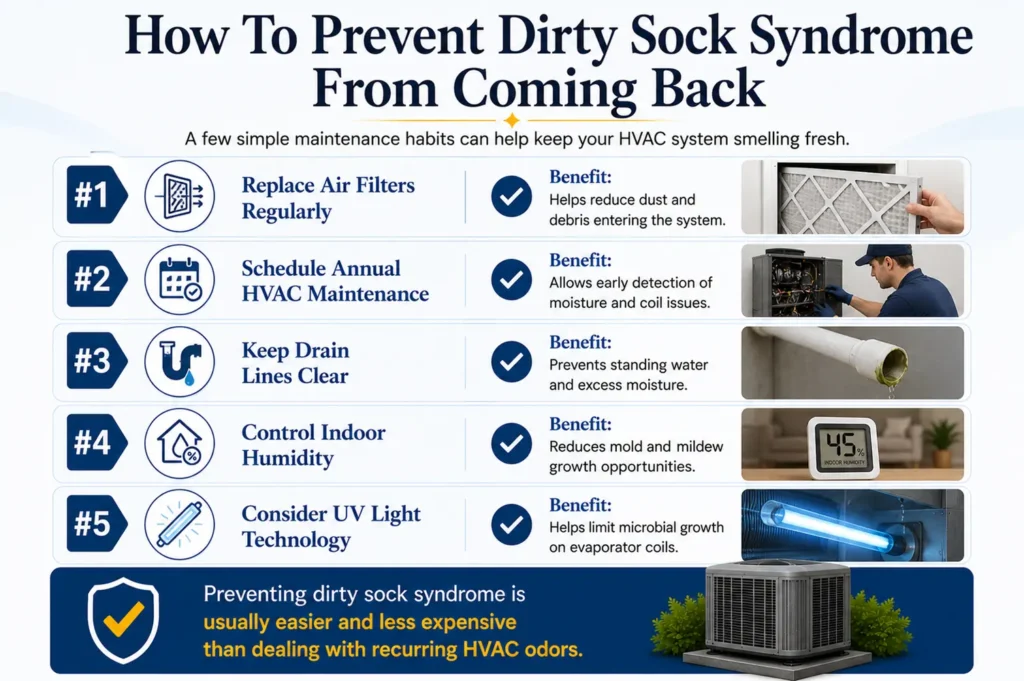
All in all, here are some of the most common dirty socks syndrome treatment options:
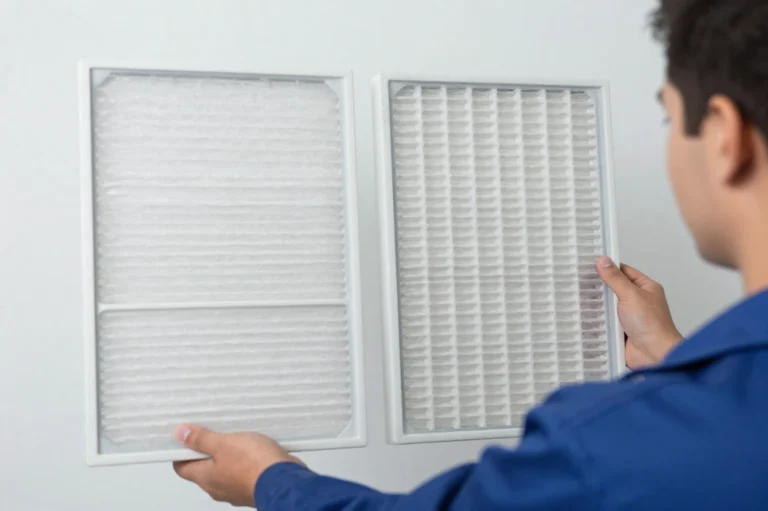
1. Replace your HVAC air filter
A dirty air filter won’t directly cause dirty sock syndrome, but it can contribute to the problem.
That’s because when HVAC filters become clogged, dust, dirt, and other airborne particles can circulate through the system more easily. These contaminants can eventually settle on HVAC components and feed microbial growth.
Replacing your filter regularly and using high-quality MERV 8 or MERV 10 air filters helps improve airflow and reduces the amount of debris entering the system.
2. Clean the evaporator coil
As we discussed earlier, mold, mildew, bacteria, and biofilm often grow on the evaporator coil because of the moisture that naturally forms during cooling.
A thorough evaporator coil cleaning removes this buildup and helps eliminate the source of the smell. For many homeowners, this is the most effective solution for persistent dirty sock syndrome AC problems.
3. Clean the condensate drain and drain pan
Your HVAC system removes moisture from the air every day. And that moisture collects in the drain pan and exits through the condensate drain line.
Now, if either of these components becomes dirty or clogged, standing water can develop. And wherever standing water exists, microbial growth often follows.
That’s why cleaning these components help eliminate odors and improve overall HVAC performance.
4. Schedule professional HVAC cleaning
Sometimes the odor extends beyond the evaporator coil. Contamination can also be present in other HVAC components, including blower assemblies, drain systems, air handlers, and ductwork.
A professional HVAC cleaning can address these areas and help restore cleaner airflow throughout the system.
This is especially important if the odor has been present for a long time or keeps returning after temporary fixes.
5. Install a UV light system
Many homeowners are surprised to learn that HVAC UV lights can help prevent microbial growth inside HVAC systems.
These systems are typically installed near the evaporator coil. Here, the ultraviolet light helps reduce mold, mildew, bacteria, and biofilm growth on coil surfaces.
While UV lights aren’t always necessary, they can be very effective for homes that repeatedly experience dirty sock syndrome.
6. Address moisture problems
Moisture is what allows dirty socks syndrome to develop in the first place.
So if your HVAC system has drainage problems, excess humidity, condensation issues, or airflow restrictions, those underlying problems should be fixed. Otherwise, the odor might eventually return even after cleaning.
In short, here’s how to get rid of dirty sock syndrome:
| Solution | Purpose |
| Replace air filter | Reduce contaminants |
| Clean evaporator coil | Remove microbial growth |
| Clean drain pan | Eliminate standing water |
| Professional HVAC cleaning | Address system-wide contamination |
| UV light installation | Help prevent regrowth |
| Fix moisture issues | Stop the problem at its source |
AC smells like dirty socks? Here’s when you should call a professional
Sometimes a simple filter replacement can help reduce odors. But there are situations where professional service is the better option.
You should consider calling an HVAC professional if:
- The smell keeps coming back
- Your AC smells like dirty socks every time it runs
- The odor is getting stronger
- You notice visible mold growth
- Your HVAC system hasn’t been cleaned in years
- You suspect evaporator coil contamination
- You experience worsening allergy or respiratory symptoms
- There is standing water inside the system
After all, the sooner the underlying issue is addressed, the easier it is to prevent further contamination and recurring odors.
Contact us to improve your indoor air
quality with our expert cleaning services in NJ.
Final words
I am sure that you now have a much clearer understanding of what dirty sock syndrome is and why it causes your HVAC system to smell unpleasant.
You see, dirty socks syndrome might not be the most serious HVAC problem, but it is definitely one that shouldn’t be ignored.
That’s because the musty odor is usually a sign of moisture, mold, mildew, bacteria, or biofilm buildup somewhere inside the system.
Thankfully, how to get rid of dirty sock syndrome is easy as it can be resolved through proper HVAC cleaning, maintenance, and moisture control.
Got more questions or need professional air duct cleaning in NJ?
You can get in touch with us!
At Clean Air Technologies, we help homeowners across New Jersey breathe cleaner air with detailed NADCA-certified air duct and HVAC system cleaning services.
FAQs about dirty sock syndrome
What is dirty sock syndrome?
Dirty socks syndrome is a musty odor that comes from an HVAC system, usually caused by microbial growth on the evaporator coil or other damp HVAC components.
Why does my air conditioner smell like dirty socks?
An air conditioner smells like dirty socks when mold, mildew, bacteria, or biofilm grow on HVAC components exposed to moisture and airflow.
Is dirty socks syndrome dangerous?
Dirty socks syndrome is usually not considered dangerous for healthy individuals. However, it can affect indoor air quality and can irritate people with allergies, asthma, or respiratory sensitivities.
Can you get sick if your HVAC smells musty?
In some cases, yes.
Some people can experience sneezing, coughing, congestion, headaches, or other allergy-like symptoms due to contaminants circulating through the HVAC system.
How to get rid of dirty sock syndrome?
The most effective solutions typically include evaporator coil cleaning, drain pan cleaning, HVAC maintenance, moisture control using a whole house dehumidifier, and in some cases UV light installation.
Does changing the air filter fix dirty socks syndrome?
Changing the air filter can help reduce contaminants inside the system, but it usually does not eliminate established microbial growth on the evaporator coil.
Why is dirty socks syndrome more common in spring?
Spring often creates ideal conditions for microbial growth because HVAC systems cycle on and off more frequently, allowing moisture to remain on the evaporator coil for longer periods.
Will dirty socks syndrome go away on its own?
Unfortunately, no.
In most cases, the odor will continue returning until the underlying microbial growth and moisture issues are properly addressed.