
If you’ve been shopping for an air filter lately, you’ve probably come across terms like MERV and HEPA.
At first, the difference seems pretty simple. MERV filters remove dust, while HEPA filters remove even smaller particles.
So, it is easy to assume that HEPA filters are the better choice.
But then, both MERV and HEPA air filters are designed for different purposes. Meaning although both help improve indoor air quality, they aren’t interchangeable.
In fact, installing the wrong filter can reduce airflow and make your HVAC system inefficient.
So, how do you know which one is right for your home?
In this blog, I will explain everything you need to know about MERV vs HEPA air filters. You’ll know:
- How these air filters differ
- Whether or not your HVAC system can use a HEPA filter
- If MERV vs HEPA is a fair comparison at all
By the end, you’ll know exactly which air filter makes the most sense for your home and your HVAC system.
So, let’s get started.
Table of Contents
Key takeaways
- MERV and HEPA measure air filtration differently and are not the same type of filter.
- HEPA filters capture much smaller particles than MERV filters.
- Most residential HVAC systems are not designed to use true HEPA filters.
- MERV 13 is the highest-rated filter that most home HVAC systems can safely handle.
- HEPA filters are commonly used in hospitals, laboratories, and portable air purifiers.
- For most homeowners, a MERV-rated filter offers the best balance of air quality and airflow.
- Always check what your HVAC manufacturer recommends before upgrading your air filter.
What is a MERV air filter?
For starters, MERV isn’t a type of air filter. It’s a rating.
MERV stands for Minimum Efficiency Reporting Value, a system that measures how well an air filter captures airborne particles. Here, the higher the MERV rating, the smaller the particles the filter can trap.
For instance, both MERV 8 and MERV 10 air filters capture dust.
But a MERV 8 filter mostly captures common household pollutants like dust, pollen, lint, and pet dander.
A MERV 10 filter, on the other hand, goes a step further by capturing even smaller particles, including finer dust, mold spores, smoke particles, and more.
Simply put, as the MERV rating increases, the filter becomes better at removing smaller airborne particles.
However, there’s a catch.
You see, as filtration improves, airflow resistance also increases. This means your HVAC system has to work a little harder to push air through the filter.
That’s why choosing the highest MERV rating isn’t always the best decision. Instead, the best MERV rating for your home is the highest one your HVAC system is designed to handle safely.


Contact us to improve your indoor air
quality with our expert cleaning services in NJ.
What is a HEPA filter?
A HEPA filter is very different from a MERV-rated filter. That’s because unlike MERV, which is a rating system, HEPA is a filtration standard.
Now, to qualify as a true HEPA filter, an air filter must capture at least 99.97% of airborne particles that are 0.3 microns in size. And this is one of the most challenging particle sizes to filter.
In simple terms, a HEPA filter removes extremely small airborne particles that many standard HVAC filters cannot capture. These include fine dust, pollen, mold spores, bacteria, smoke particles, and many other microscopic pollutants.
It is because of this high level of filtration that HEPA filters are commonly used in places where very clean air is important, such as hospitals, medical facilities, laboratories, etc.
You’ll also find HEPA filters in many commercial vacuum cleaners. For instance, at Clean Air Technologies, our technicians use HEPA-rated vacuums for air duct cleaning in NJ.
Can you use a HEPA filter in your HVAC system?
Mostly no.
A HEPA filter is much denser than your typical residential HVAC filter. And since it traps so many tiny particles, air doesn’t pass through it as easily.
For most home HVAC systems, that’s a problem. That’s because your HVAC’s blower motor has to work much harder to move air through a HEPA filter.
In fact, many residential HVAC systems aren’t even designed for that level of airflow resistance.
That’s why HEPA filters are rarely installed as the primary filter inside a standard home HVAC system.
MERV vs HEPA air filters: What’s the difference?

Now that you know what both filters are, let’s talk about the difference between MERV vs HEPA air filters.
Simply put, both filters clean the air, but they do it at different levels and for different purposes.
A MERV-rated filter is designed to balance air filtration with proper airflow through your HVAC system.
A HEPA filter, on the other hand, is designed to remove extremely tiny airborne particles. It offers much higher filtration, but because it’s much denser, it also restricts airflow in residential HVACs.
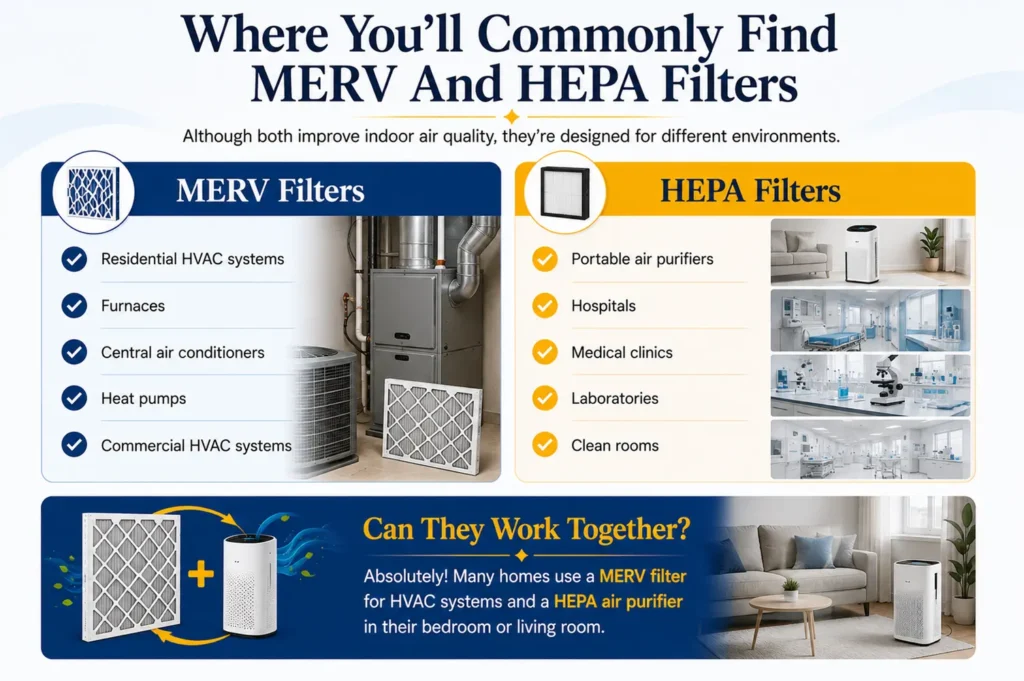
That’s why most homes use MERV filters in their HVAC systems because they’re of the standard HVAC filter sizes. HEPA filters, at the same time, are found in portable air purifiers or specialized ventilation systems.
Here’s a quick comparison of MERV vs HEPA air filters:
| Feature | MERV Filter | HEPA Filter |
| What it is | An air filter with a MERV efficiency rating | A filter that meets the HEPA filtration standard |
| Filtration level | Varies by MERV rating | Captures at least 99.97% of 0.3-micron particles |
| Best use | Residential HVAC systems | Air purifiers, hospitals, laboratories |
| Airflow resistance | Low to moderate | High |
| HVAC compatibility | Most residential systems are compatible | Most residential HVAC systems cannot use HEPA filters |
| Best for | Everyday air filtration | Maximum particle removal |
Okay, now that you know the biggest differences between MERV vs HEPA air filters, let’s have a look at the most important differences in detail.
1. MERV is a rating, while HEPA is a filtration standard
People compare HEPA filter vs MERV rating as though they’re two different filter types. But that’s not the case.
A MERV rating measures how efficiently an air filter captures airborne particles. A HEPA filter, on the other hand, is built to meet a very specific filtration standard.
In other words, one is a rating system, while the other is a filter classification.
2. HEPA filters capture much smaller particles
When it comes to filtration alone, HEPA filters outperform MERV-rated filters.
A HEPA filter captures at least 99.97% of particles that are 0.3 microns in size, including extremely fine dust, smoke, bacteria, and many other microscopic particles.
MERV filters also remove airborne contaminants, but the amount depends on the filter’s rating.
For instance, a MERV 8 filter captures common household dust and pollen, while a MERV 13 filter removes much finer particles than lower-rated filters.
However, for everyday residential use, homeowners say that a MERV-rated filter already provides excellent indoor air quality.
3. MERV filters are designed for HVAC systems
This is where HEPA vs MERV air filters distinction becomes much easier to understand.
Most residential HVAC systems are built to use MERV-rated filters. These filters are designed to remove airborne particles while still allowing enough air to move freely through the system.
HEPA filters are much denser. And because of that, they require much more airflow than most home HVAC systems can provide.
That’s why HEPA filters are rarely installed as the main filter inside residential heating and cooling systems.
4. HEPA filters create much higher airflow resistance
Every air filter creates some resistance as air passes through it. That’s because the better a filter is at trapping tiny particles, the denser it usually becomes.
Since HEPA filters are designed for extremely high filtration, they naturally create much more resistance than MERV filters.
For homeowners, this simply means that your HVAC system has to work much harder to move air through a HEPA filter.
And if your HVAC system isn’t designed for that resistance, airflow can decrease, and your equipment might experience unnecessary.
That’s one of the biggest reasons I never recommend replacing your standard furnace filter with a HEPA filter during routine air filter replacements.
MERV 13 vs HEPA air filter: Which one is better?
The answer isn’t as straightforward as you might think.
If we’re talking strictly about filtration efficiency, HEPA is more effective as it captures significantly smaller airborne particles than a MERV 13 filter.
However, that doesn’t automatically make it the better choice for every home.
A MERV 13 filter is often considered the highest MERV rating that most modern residential HVAC systems can safely handle. It provides excellent filtration for fine dust, pollen, mold spores, smoke particles, bacteria, and many other airborne contaminants while still maintaining proper airflow in systems designed for it.
Ofcourse, a HEPA filter goes even further. But because it’s much denser, most residential HVAC systems simply aren’t built to use one as their primary air filter.
That’s why, for many homeowners, MERV 13 filters vs HEPA isn’t really a competition.
Instead, they serve different purposes.
A MERV 13 filter protects both your indoor air quality and your HVAC system.
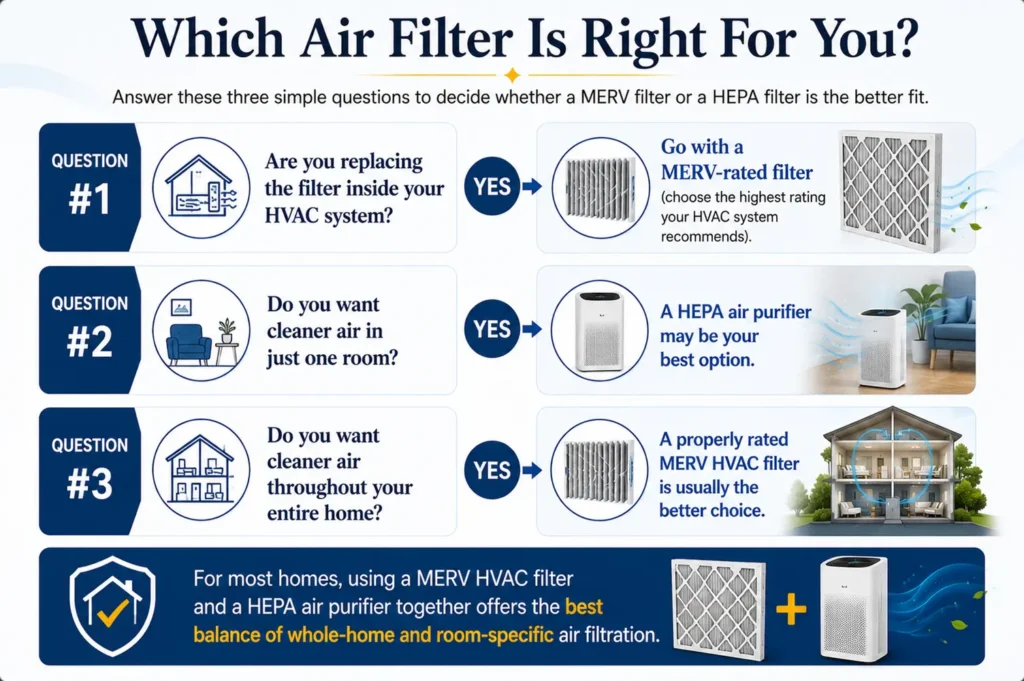
A HEPA filter is used in a portable air purifier when you want an additional layer of air cleaning in some rooms.
So, is MERV 13 better than HEPA?
Not necessarily.
If your goal is the highest possible particle removal inside an air purifier, HEPA is the better option.
But if you’re choosing an air filter for your home’s HVAC system, MERV 13 is more practical if your HVAC manufacturer approves that rating.
Can HVAC use HEPA filters?
In most cases, no.
Since HEPA filters are much denser than standard HVAC air filters, they create significantly more airflow resistance. And most residential HVAC systems aren’t designed to push air through them efficiently.
If you install a HEPA filter in a system that isn’t built for it, you could run into problems like:
- Reduced airflow throughout your home
- Your HVAC system working harder than necessary
- Higher energy bills
- Extra wear on the blower motor over time
Now, that doesn’t mean you can’t use HEPA filters at home.
Some homes have whole-house HEPA air purification systems that are installed alongside the HVAC system. These systems are designed differently and include their own fans or bypass setups, allowing them to clean the air without restricting the main airflow.
But for the average residential HVAC system, replacing your regular furnace filter with a HEPA filter is something I don’t recommend.
Bonus: Here’s how to decide between MERV vs HEPA air filters
| Choose a MERV filter if: | Choose a HEPA filter if: |
| You need a filter for your HVAC system | You use a portable air purifier |
| You want balanced airflow and filtration | You want maximum particle removal |
| You want whole-home air filtration | You want cleaner air in one room |
| Your HVAC manufacturer recommends MERV filters | You need additional filtration for allergies or asthma |
Final words
I hope you now have a much clearer understanding of the difference between MERV vs HEPA air filters.
You see, while HEPA filters provide a higher level of filtration, that doesn’t necessarily make them the better choice for every home.
For most homeowners, a properly selected MERV-rated filter offers the ideal balance of clean indoor air, healthy airflow, and reliable HVAC performance.
If you want an extra layer of air cleaning, adding a HEPA air purifier to the rooms you use most can be a great complement to your HVAC filter.
Still unsure which air filter is best for your home?
You can get in touch with us!
At Clean Air Technologies, we offer high-quality MERV-rated air filters. And we are here to help you choose the right option based on your HVAC system, indoor air quality concerns, and your home’s specific needs.
Contact us to improve your indoor air
quality with our expert cleaning services in NJ.
FAQs about MERV vs HEPA air filters
Is HEPA better than MERV?
HEPA filters remove smaller airborne particles than MERV-rated filters, so they provide a higher level of filtration.
However, that doesn’t automatically make them the better choice for your home. That’s because most residential HVAC systems are designed to use MERV-rated filters, not true HEPA filters.
HEPA filter vs MERV 13 for allergies: What’s better?
If you’re using a portable air purifier, a HEPA filter is generally better for allergies because it captures extremely small airborne particles that can trigger allergy symptoms.
However, if you’re choosing an HVAC filter, a MERV 11 or MERV 13 filter is often the best practical option for improving indoor air quality throughout your home.
Can I replace my HVAC filter with a HEPA filter?
In most homes, you shouldn’t.
True HEPA filters are much denser than standard HVAC filters and can significantly restrict airflow if your system isn’t designed for them. This can reduce heating and cooling performance and put extra strain on your HVAC equipment.
Is MERV 13 as good as HEPA?
No.
A HEPA filter captures much smaller airborne particles than a MERV 13 filter. However, MERV 13 still provides excellent filtration for most residential homes and is often the highest MERV rating many HVAC systems can safely accommodate.
For whole-home HVAC filtration, MERV 13 is usually the more practical choice.
What’s the best MERV rating for home use?
It depends on your HVAC system and your indoor air quality needs. MERV 8 is suitable for most homes and offers reliable everyday filtration.
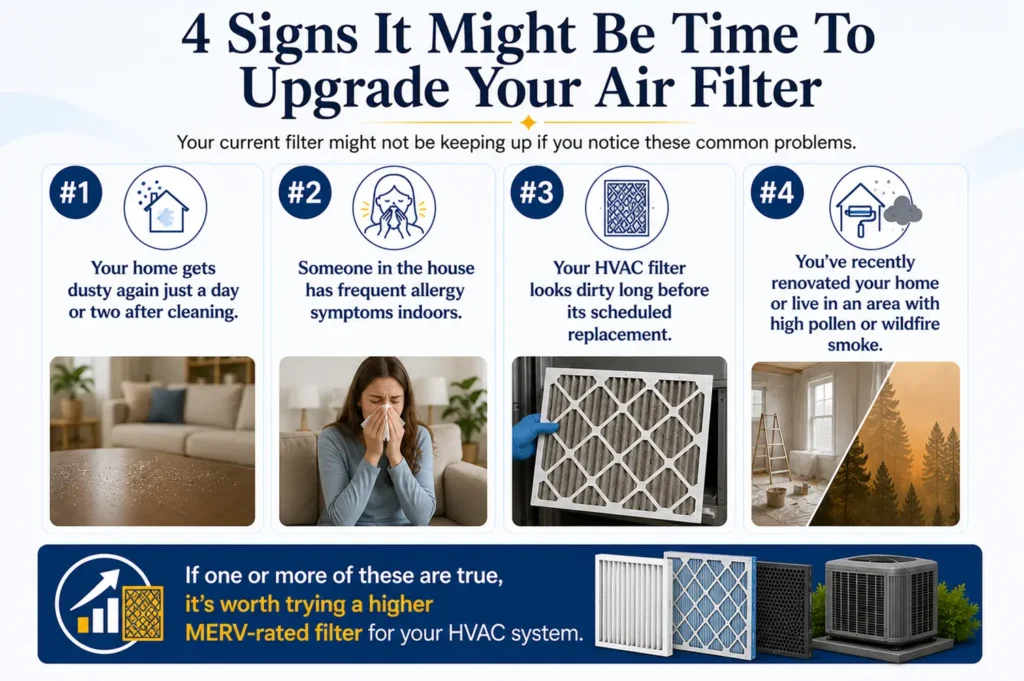
If someone in your home has allergies, pets, or you’re looking for cleaner indoor air, MERV 11 and MERV 13 air filters are a better choice. But only if your HVAC system is designed to handle that level of filtration.
Should I use both a MERV filter and a HEPA air purifier?
For many homeowners, yes.
A MERV-rated filter helps clean the air throughout your home every time your HVAC system runs, while a portable HEPA air purifier provides additional filtration in specific rooms.
Together, they can significantly improve indoor air quality without putting unnecessary strain on your HVAC system.