
Ever stood in the HVAC filter aisle at Home Depot staring at a wall of boxes?
You might have thought, why are there so many sizes, and how am I supposed to know which one is right?
Well, we’ve all been there.
In fact, this is one of the most common questions I hear from homeowners all across New Jersey.
And, it makes sense. After all, HVAC filter sizing feels way more complicated than it should be.
One filter looks almost right, another says it’s standard, and suddenly you’re second-guessing everything.
The good news?
It is actually much simpler once you know the standard HVAC filter sizes.
In this guide, I will break it all down. You’ll know:
- Which HVAC filter sizes are most common in New Jersey homes
- How to measure your filter the right way
- Why the size printed on the filter doesn’t always match what you measure at home
And a lot more.
By the end, you should be able to choose the right filter with confidence.
So, let’s get started.
Table of Contents
Key takeaways
- There is no single standard HVAC filter size for all New Jersey homes
- Most NJ homes use 1-inch filters, especially 16×25×1 and 20×25×1 filters
- Thicker filters (2-inch and 4-inch) only work if your system is built for them
- The size printed on the filter is a rounded nominal size, not the exact measurement
- Using the wrong size can cause gaps, dirt buildup, and airflow problems
- Always match the filter size and thickness your system was designed to use
What are the most common HVAC filter sizes used in New Jersey homes?
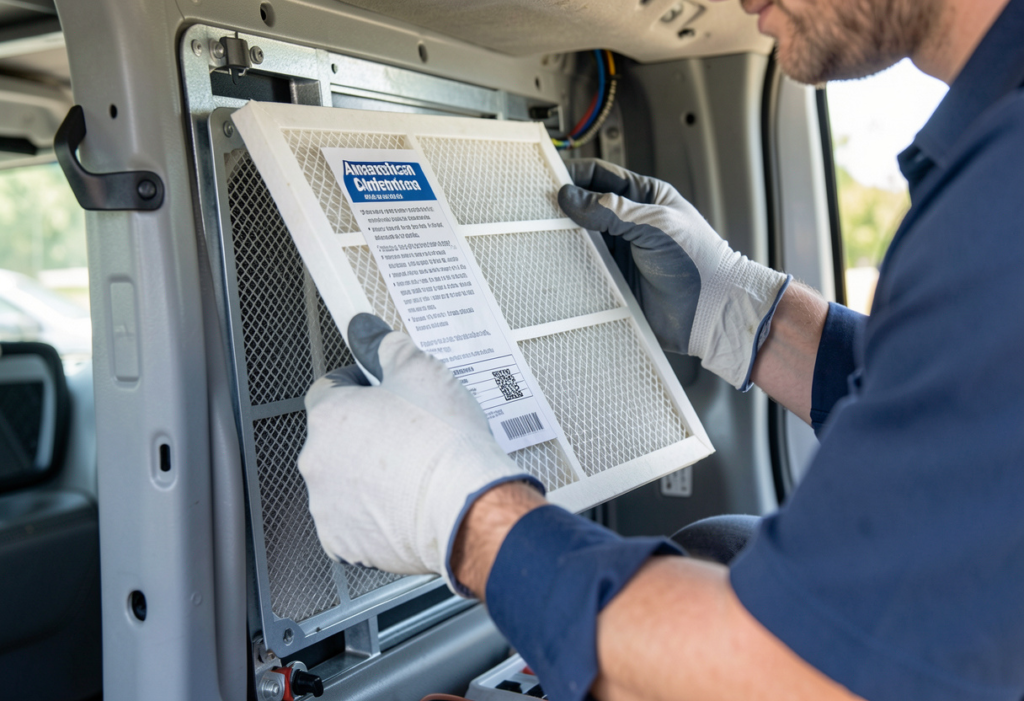
When it comes to HVAC filters in New Jersey, there isn’t just one standard size. However, some sizes show up far more often than others.
In fact, be it a single-family home, townhouse, or apartment, your system likely uses either one or a mix of some common filter sizes.
So, just know these sizes and your HVAC filter shopping will be much easier.


Schedule Your Free Estimate Today
Contact us to improve your indoor air
quality with our expert cleaning services in NJ.
Overall, here are the most common residential air filter sizes:
1. 1-inch HVAC filters (most common in New Jersey Homes)
One-inch HVAC filters are the most common filter type we see in New Jersey homes. If your home has a typical furnace or air handler and a single return grille, there’s a very good chance you’re using a 1-inch filter.
These filters have been around for decades, which is why they’re easy to find almost anywhere, including at hardware stores, big box stores, and online. They’re also what most older HVAC systems were designed to use.
Here are the 1-inch sizes I see most often in NJ homes and where they usually show up:
- 14 × 20 × 1: Common in smaller systems, condos, and apartments
- 16 × 20 × 1: Often used in townhomes and compact HVAC setups
- 16 × 25 × 1: Very common in single-family homes
- 20 × 20 × 1: Frequently found in older homes with square return grilles
- 20 × 25 × 1: One of the most popular filter sizes in New Jersey overall
Here’s why homeowners like 1-inch filters:
- They’re inexpensive
- They’re easy to find in almost any store
- They fit most older HVAC systems without modifications
Things you should keep in mind:
- They clog faster than thicker filters
- Most need to be changed every 1 to 2 months
- They have less surface area, so they don’t hold as much dust
Pro tip: If you’re using a 1-inch filter, you should stay on top of air filter replacement. That’s because waiting too long can restrict airflow and make your system work harder than it should.
In short, here are the most common 1-inch HVAC filter sizes in New Jersey:
| Filter Size | Where It’s Commonly Used |
| 14×20×1 | Apartments, condos, small systems |
| 16×20×1 | Townhomes and compact HVAC setups |
| 16×25×1 | Many single-family homes |
| 20×20×1 | Older homes with square return vents |
| 20×25×1 | One of the most common sizes in NJ homes |
2. 2-inch HVAC filters
Two-inch HVAC filters are becoming more common in New Jersey, especially in newer homes or systems that have been upgraded over the years.
These are a nice middle ground between basic 1-inch filters and the larger 4-inch filters used in high-efficiency systems.
The most common 2-inch filter sizes I see are:
- 16 × 25 × 2
- 20 × 20 × 2
- 20 × 25 × 2
Homeowners tend to like 2-inch filters because they simply do more than a standard 1-inch filter without being a major change to the system.
Here’s why 2-inch HVAC filters are becoming popular:
- They have more surface area, so they can hold more dust and debris
- They usually last longer and need fewer replacements over the year
- They can support better overall filtration while keeping airflow steady
Things you should keep in mind:
- They only work if your system is designed for a 2-inch filter
- You cannot safely squeeze a 2-inch filter into a 1-inch slot
Pro tip: If your system already uses a 2-inch filter, you should stick with the correct filter size and replace it on schedule
In short, here are the most common 2-inch HVAC filter sizes in New Jersey:
| Filter Size | Typical Homes |
| 16×25×2 | Upgraded single-family homes |
| 20×20×2 | Newer HVAC setups |
| 20×25×2 | Homes needing better filtration |
3. 4-inch HVAC filters
Four-inch HVAC filters are usually found in high-efficiency HVAC systems and homes that have been built or upgraded more recently.
These are often called deep media filters, and they’re designed to do a much better job at filtering air without hurting airflow.
The most common 4-inch HVAC filter sizes you’ll see in New Jersey homes are:
- 16 × 25 × 4
- 20 × 20 × 4
- 20 × 25 × 4
You’ll typically find 4-inch filters in:
- Newer homes
- Homes with upgraded HVAC systems
- Systems that have a dedicated filter cabinet built into the ductwork
Here’s why homeowners like 4-inch filters:
- They have a much larger surface area
- They’re great for homes with pets, allergies, or higher dust levels
- They load with dirt more slowly, so airflow stays consistent
- They often last 4 to 6 months between changes
Things you should keep in mind:
- They cost more upfront than thinner filters
- They require a proper filter cabinet
Pro tip: You should never try to upgrade to a 4-inch filter unless your system was designed for it. That’s because if the slot isn’t made for a thicker filter, forcing one in can block airflow and create HVAC problems instead of solving them.
Note: If you’ve been experiencing poor airflow, the problem might not be with the filter but clogged vents and ducts. So, before going for a thinner filter, you should first get a proper HVAC system cleaning.
In short, here are the most common 4-inch HVAC filter sizes in New Jersey:
| Filter Size | Where You’ll Find Them |
| 16×25×4 | Newer homes |
| 20×20×4 | High-efficiency systems |
| 20×25×4 | Homes with filter cabinets |
4. Less common (but still standard) HVAC filter sizes
Not every New Jersey home uses one of the popular filter sizes above, and that’s completely normal.
I regularly see plenty of homes with filter sizes that aren’t as common on store shelves but are still standard residential sizes.
And some of these less common sizes I often run into include:
- 10 × 20 × 1
- 12 × 12 × 1
- 12 × 24 × 1
- 14 × 25 × 1
- 18 × 30 × 1
- 24 × 24 × 1
These filter sizes usually show up in:
- Older homes built before today’s typical HVAC layouts
- Finished basements with their own return grille
- Home additions where a system was modified or extended
- Converted systems that were updated over time
So, if your filter size is on this list, it doesn’t mean anything is wrong with your system. It just means your home has a unique layout or has been changed over the years, which is very common.
In short, here are the less common HVAC filter sizes in New Jersey:
| Filter Size | Where They’re Used |
| 10×20×1 | Older or compact systems |
| 12×12×1 | Small return vents |
| 12×24×1 | Custom layouts |
| 14×25×1 | Modified systems |
| 18×30×1 | Larger return openings |
| 24×24×1 | Wide square returns |
Nominal vs actual air filter sizes for homes: What’s the difference?
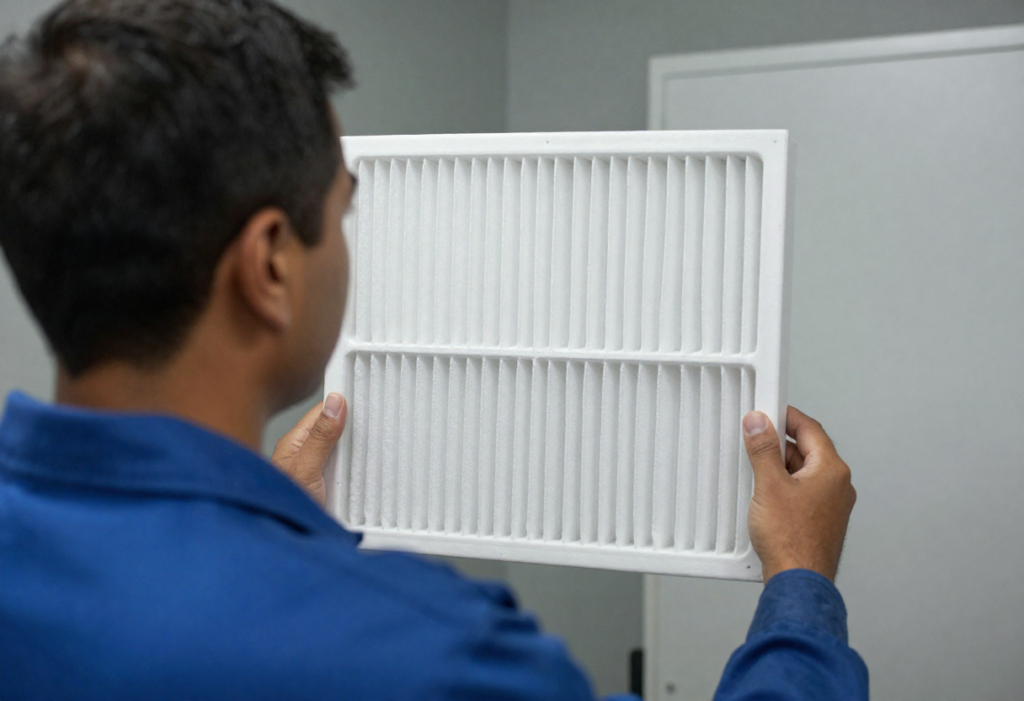
This is one of the most confusing parts of buying an HVAC filter, and it trips up a lot of homeowners.
You see, the size printed on the filter box is called the nominal size. And it is not the exact physical measurement of the filter.
This is done on purpose.
For instance, a filter labeled 16 × 25 × 1 will usually measure a little smaller, something like 15.5 × 24.5 × 0.75 inches. That small difference allows the filter to slide in and out of the slot without getting stuck.
Here’s the simple way to think about it:
- The number on the filter box means nominal size
- The real, tape-measure size means actual size
This is completely normal and does not mean the filter is wrong or poorly made.
So, when you’re shopping for a filter replacement, always buy the filter using the printed size from your old filter, not the exact measurements you get with a tape measure. That’s because measuring and guessing often leads to buying the wrong size and creating gaps around the filter.
In short, here’s the difference between nominal vs actual air filter sizes for homes:
| Term | What It Means |
| Nominal size | The size printed on the filter box |
| Actual size | The real measured size |
| Why it’s smaller | Helps the filter slide in easily |
How to measure your HVAC filter size correctly?
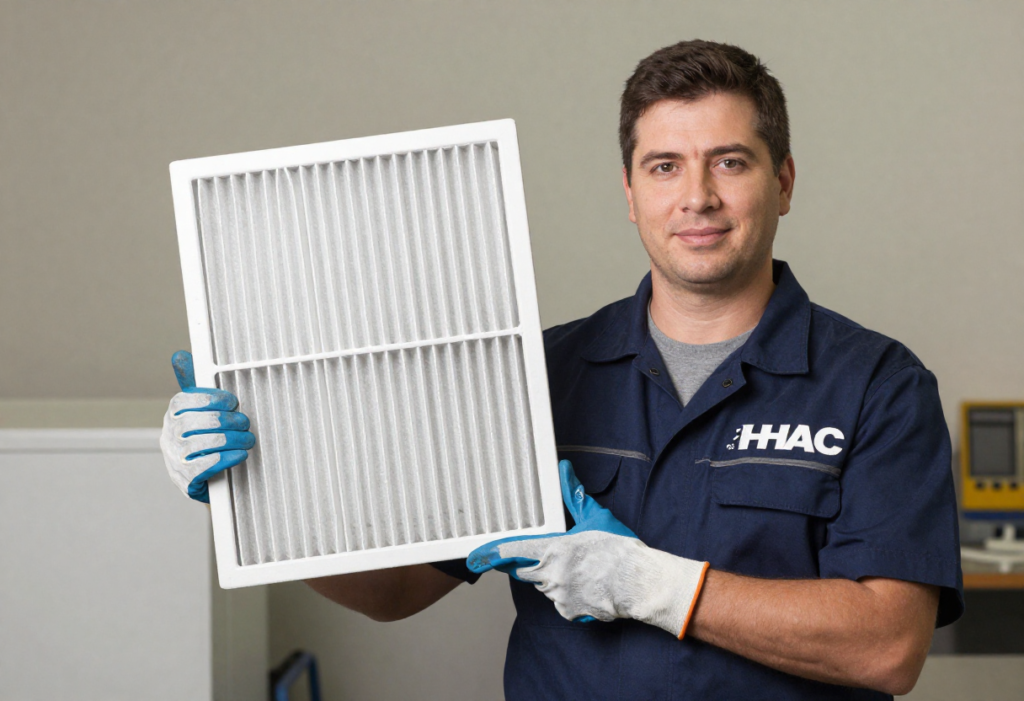
Sometimes your old filter is missing or the label has worn off. But you can still measure your HVAC filter.
The trick is to measure the filter frame (not the pleated cardboard) and round to the nearest inch.
Here’s a simple step-by-step guide to do so:
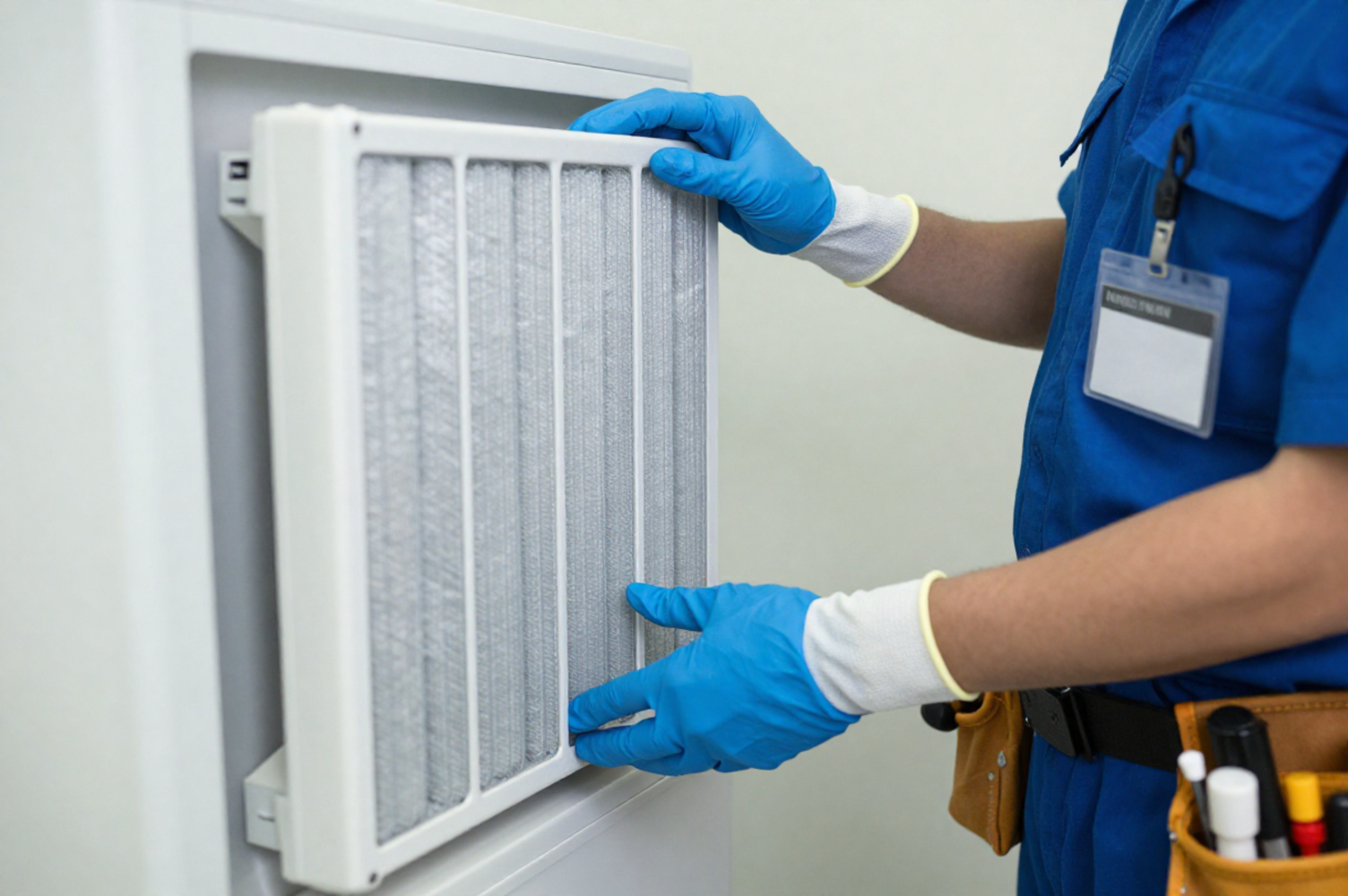
Step 1: Remove the old filter
Take the filter out of the slot completely. Make sure the system is off so it’s safe.
Removing it fully gives you the best access to measure the exact frame size, and it prevents bending or damaging the filter.
Step 2: Measure the frame, not the cardboard
Check the length, width, and thickness of the filter frame using a tape measure. Don’t measure the pleated part, just the rigid edges.
This gives you the true size that fits the slot properly.
Step 3: Round to the nearest whole number
Take the measurements you recorded and round each one up or down to the nearest inch. For instance, 15.5 inches becomes 16, and 24.5 becomes 25.
This rounded number is your nominal size, the one you’ll use when buying a new filter.
In short, here’s how to measure your HVAC filter size correctly:
| Step | What To Do |
| Step 1 | Turn system off and remove filter |
| Step 2 | Measure the filter frame |
| Step 3 | Round measurements to nearest inch |
You might also want to read: Can You Put A Filter On Return Air Vent?
Schedule Your Free Estimate Today
Contact us to improve your indoor air
quality with our expert cleaning services in NJ.
Final words
By now, I am sure you know what are the standard HVAC filter sizes used in New Jersey homes.
You see, there really isn’t a single standard HVAC filter size for all homes in Jersey. But then, a few sizes are very common, like 16 × 25 × 1, 20 × 25 × 1, 16 × 20 × 1, and 20 × 20 × 1, along with their 2-inch and 4-inch versions.
Still not sure what’s the right HVAC filter size for your home or want to get a filter replacement?
You can get in touch with us!
At Clean Air Technologies, we offer the highest-quality MERV-rated air filters for both home and commercial properties. Our filters are designed to keep your indoor air clean and healthy to breathe throughout.
We also offer recurring filter replacement plans to help you stay on top of HVAC filter replacement.
FAQs about HVAC filter sizes
What is the most common HVAC filter size in New Jersey homes?
In most New Jersey homes, the most common HVAC filter sizes are 16×25×1 and 20×25×1.
These sizes are very popular in single-family homes and newer townhouses.
However, there is no single standard size for every home. Your system’s filter slot decides the size, not your house size.
So, always check the size printed on your current filter before buying a replacement.
How do I know the correct HVAC filter size for my system?
The easiest way is to remove your current filter and read the size printed on the frame, such as 16×25×1. That number is your nominal size and is what you should use when shopping.
If the label is missing, measure the filter opening and round each measurement to the nearest whole inch.
Do not guess, because the wrong size can allow dirty air to bypass the filter.
Can I use a different filter size if it almost fits?
No, you should never use a filter that only almost fits.
Even small gaps around the edges let dust and debris go straight into your HVAC system. This can dirty your blower, coils, and ductwork and reduce system efficiency.
A filter should fit snugly in the slot without bending or forcing it in. The correct size is very important for both air quality and system protection.
What does the third number in a filter size mean?
The third number in a filter size shows the thickness of the filter. For instance, in a 16×25×1 filter, the ‘1’ means the filter is one inch thick.
Some systems use thicker filters such as 2-inch or 4-inch filters. You must use the same thickness your system is designed for.
Thicker filters only work if your HVAC system has the proper filter cabinet.
Are 4-inch HVAC filters better than 1-inch filters?
In many homes, 4-inch filters can be better because they have more surface area and can hold more dust while maintaining good airflow. They also usually last longer between changes.
However, you can only use a 4-inch filter if your HVAC system has a proper deep filter cabinet.
You should never try to upgrade to a thicker filter unless your system was designed for it.
Why do my filter measurements not match the size printed on the filter?
This happens because HVAC filters use nominal sizing. The printed size is rounded and slightly larger than the real physical size.
For instance, a filter labeled 16×25×1 is usually a little smaller so it can slide into the slot easily. This is completely normal and does not mean the filter is wrong.
You should always shop using the printed size, not the exact measured size.
Should I use the same filter size if I have more than one HVAC system?
Not always.
Many New Jersey homes have two HVAC systems, such as one for the main floor and one for the basement or second floor. Here, each system can use a different filter size.
So, you should check the filter location for each unit and confirm the size separately. Never assume both systems use the same filter, even if they are in the same house.