
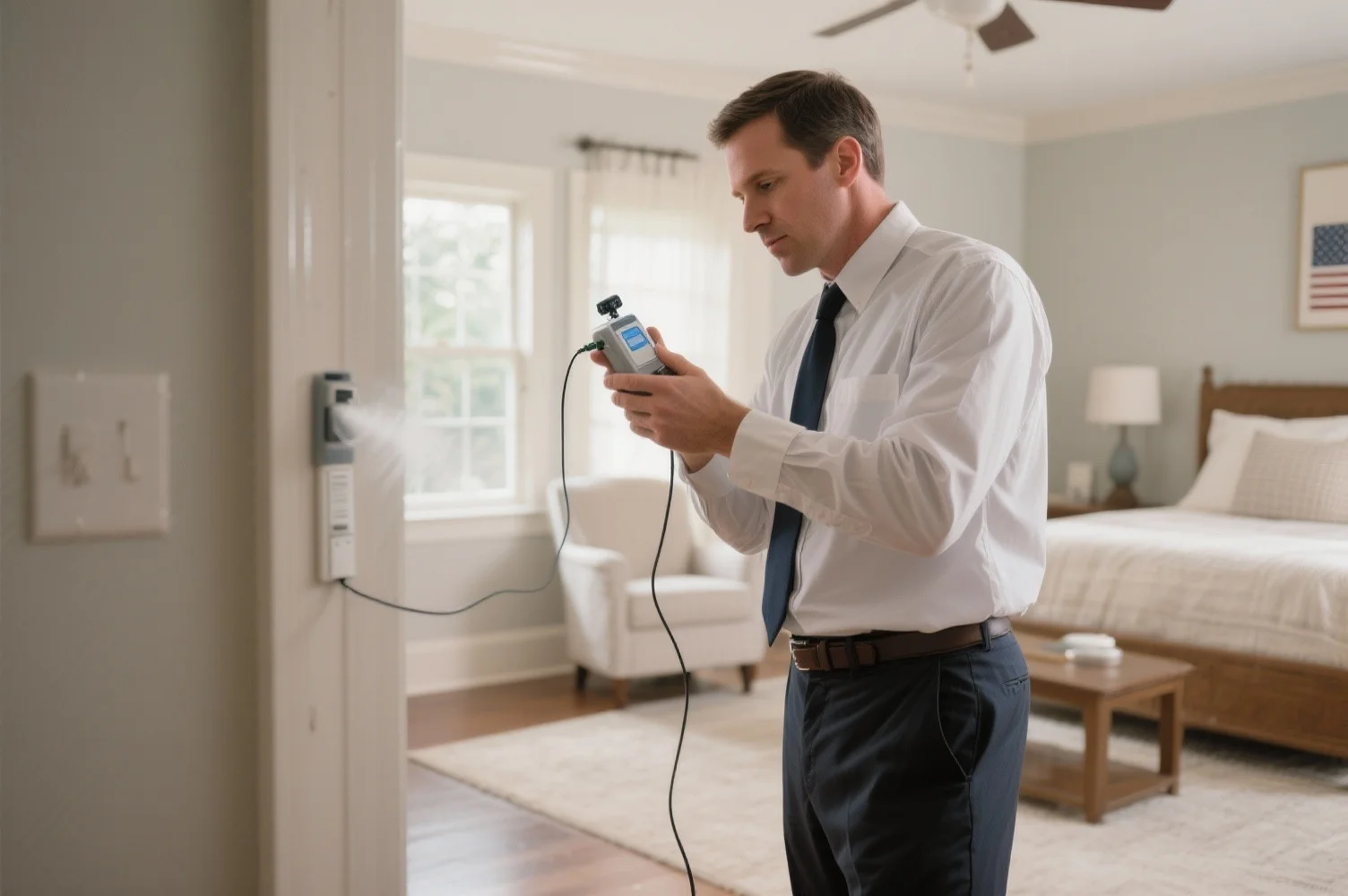
We spend most of our time indoors working, relaxing, or sleeping. But we rarely stop to think about what’s floating around in that air.
As an indoor air quality testing expert, I’ve seen everything from dust to mold spores to radon gas and VOCs quietly build up indoors.
And this is where IAQ testing comes in. It is a simple way to check what’s in your home’s air and identify pollutants or health risks.
A testing like this is particularly essential in New Jersey as its mix of humid summers and older properties makes us more prone to mold and radon issues.
But how much does indoor air quality testing cost in New Jersey?
That’s the first question you’d have as a homeowner.
The reality is, although most people in NJ pay in the range of $300-$600, pricing can vary significantly.
In this blog, I will break it all down clearly. You’ll Know:
- The indoor air quality testing cost you can expect for your home
- The factors that affect total cost
- How to get the best price for IAQ testing
So, let’s get started.
Table of Contents
Key takeaways
- Indoor air quality testing in NJ costs $300-$600 on average.
- Prices vary by test type (mold, radon, VOCs, etc.) and home size.
- Full IAQ testing bundles can save money compared to individual tests.
- Mold, radon, and VOCs are common air quality concerns in NJ homes.
- Check if labs are accredited to ensure reliable results.
- Off-season testing can save you 5-15% on costs.
How much does indoor air quality testing cost in NJ exactly?

You can expect to pay between $300-$600 for a standard professional indoor air quality testing in NJ. More so if you bundle the usual checks like mold testing, VOC screening, and radon spot-checks.
However, individual tests can cost less or more depending on the scope of work. Here, the testing method and the number of samples taken determine how much you pay.
Below is a breakdown of individual indoor air quality tests and their costs:
| Test Type | Average Cost Range in NJ | Typical National Average | When to Choose It |
| Mold | $300-$800 | $300-$1,000 | Visible mold, musty smell, water damage, post-flood |
| Radon | $150-$600 | $150-$800 | Basements, older homes, high radon zones |
| VOCs (chemical panel) | $150-$400 | $100-$400 | After renovation, new furniture, chemical odors |
| Allergens | $100-$300 | $100-$300 | Allergy or asthma symptoms, pets, seasonal reactions |
| Asbestos | $250-$800 | $250-$800 | Pre-1980 construction, renovation of old materials |
| Full Home IAQ Testing | $400-$800 | $400-$1,000 | Complete home check, best for buyers or properties with major concerns |
Let’s have a detailed look at how much each of these tests cost and why:
Mold testing
What it tests: Mold testing looks for airborne mold spores and/or mold on surfaces. Lab reports detail species and spore counts so you can see whether levels are normal or elevated.
When to do it: If you see mold, smell a persistent musty odor, have had water damage, or notice allergy symptoms. Also, you can schedule it after a flood or water leakage.
Cost range in New Jersey: $300-$800.
What affects price:
- Number of samples (each extra room or area raises lab fees).
- Type of sampling out of air samples, surface swabs, or tape lifts (combined air and surface test costs more).
- Use of active pumps or spore traps (better equipment costs more).
- Lab result time, including rush results.
- Whether or not the inspector includes a written remediation plan.
Radon Testing
What it tests: Radon tests measure the level of radon gas (a radioactive gas that can enter via foundation cracks). These tests give a reading in picocuries per liter (pCi/L).
When to do it: Always test if you have a basement or you live in a known radon area. Also, go for it when you’re buying/selling a home, or after foundation work. Radon is especially important in NJ basements and crawlspaces.
Cost range in New Jersey: $150-$600.
What affects price:
- Short-term vs long-term testing kits (short-term kits are cheaper but less reliable; long-term gives a better average).
- Number of testing locations (multiple floors/areas will need more kits).
- Professional monitors vs DIY test kits (professional devices and lab analysis cost more than a do-it-yourself kit but are more reliable).
- Follow-up confirmatory testing if the first test is elevated.


Schedule Your Free Estimate Today
Contact us to improve your indoor air
quality with our expert cleaning services in NJ.
VOC (volatile organic compounds) testing
What it tests: VOC testing checks for chemicals released by paints, adhesives, new furniture, cleaning products, and building materials. Labs might also run a general VOC panel or targeted chemical tests.
When to do it: After renovations, new carpeting or cabinetry, or when you notice strong chemical smells or headaches/dizziness in the home.
Cost range in New Jersey: $150-$400 (depending on number of compounds tested).
What affects price:
- Which VOCs are included in your test. Basic panels cost less while extended panels test dozens of chemicals cost more.
- Sampling method (canisters and active samplers are pricier than passive badges).
- Number of sample locations and how long the sampling runs.
- Lab testing complexity. For instance, GC-MS (gas chromatography–mass spectrometry) lab analysis costs more but is more precise.
Allergen testing
What it tests: Allergen testing includes airborne allergen sampling for dust mite, pollen, and pet dander, as well as surface dust analysis. Here, test results help you link allergy symptoms to real exposure.
When to do it: If you or your family members have persistent allergy or asthma symptoms, especially when symptoms improve away from home.
Cost range in New Jersey: $100-$300.
What affects price:
- Number of allergens included in the test.
- Sample type (air samples vs. dust collection method).
- Whether or not you request a healthcare-grade immunoassay or lab panel is requested.
Asbestos testing
What it tests: Asbestos testing checks areas like ceiling tiles, pipe insulation, and floor tiles for asbestos fibers. Here. professions collect a small sample and send it over to a lab.
When to do it: If your home was built before 1980, before you undertake major renovations, or if you’re tearing out old building materials.
Cost range in New Jersey: $250-$800 (you’re often charged per sample).
What affects price:
- Number of samples taken from different materials.
- Whether or not the contractor uses EPA-approved collection and lab protocols.
- Inspection plus lab testing vs. lab-only analysis.
Full home package
What it tests: This is a combined package that includes multiple sample types. For instance, a full home package will test for mold screen, VOC spot, radon, and general allergens. Also, you will get an indoor air quality test report prepared by experts.
When to do it: A full home package is best if you’re buying or selling a home, or when you simply want to get a complete picture.
Cost range in New Jersey: $400–$800 for a typical single-family home.
What affects price:
- Number of samples and scope of testing (for instance, deeper testing increases cost).
- Whether or not you want to include a detailed written report and remediation recommendations.
- Travel fees for technicians if you’re outside major metro areas.
What affects your indoor air quality testing cost?
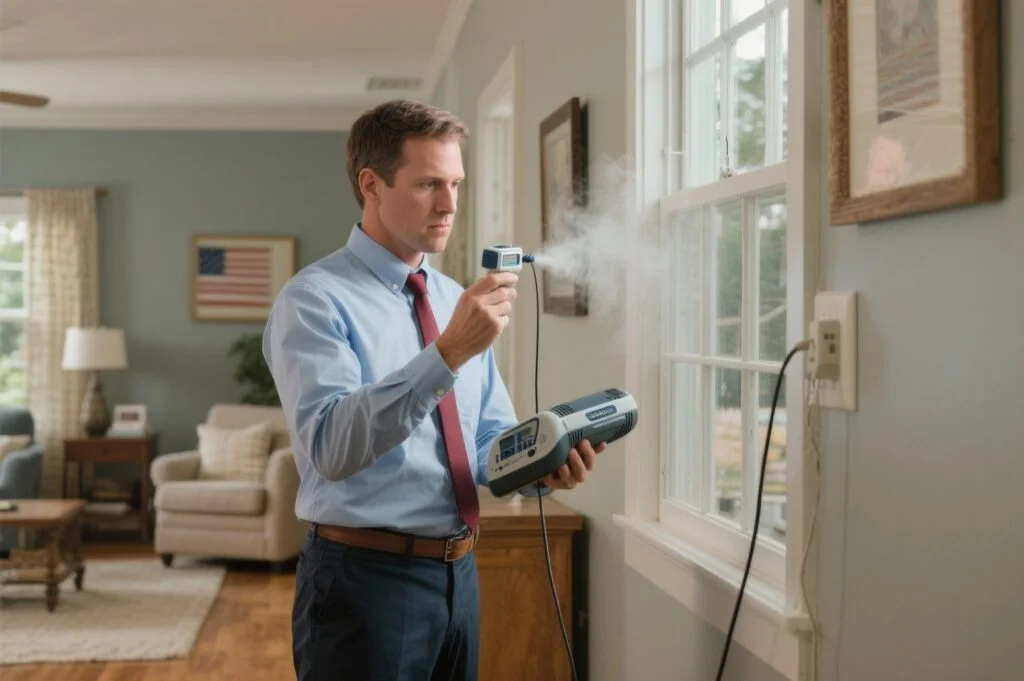
If you’ve started calling around for quotes, you’ve probably noticed prices for indoor air quality testing in New Jersey can vary quite a bit.
And that’s mainly because there are many factors that determine how much you’ll end up paying. This includes test type, your home’s size and location, testing equipment used, and much more.
Let me break them all down for you.
1. Type of test
This is the biggest factor that decides how much does indoor air quality testing cost.
You see, each kind of IAQ test looks for something different, and that means in different tools, lab methods, and costs.
Here are different IAQ tests, for instance, and how they affect the final cost:
- Mold tests often require air and surface samples, plus lab analysis to identify the type of spores.
- Radon testing uses either a short-term detector or a continuous digital monitor, which can change the price.
- VOC (volatile organic compounds) testing involves sending samples to a certified lab, which can add to the cost.
- Asbestos testing requires safety gear, sealed collection, and specialized labs, making it one of the pricier options.
- Allergen testing (for dust mites, pet dander, pollen, etc.) is generally simpler and cheaper because it uses basic sample kits.
In short, the more complex the testing and lab analysis, the higher the cost.
2. Home size and number of samples
A one-bedroom condo and a 3,000-square-foot family home will need very different testing plans.
That’s because larger homes mean more air samples, more rooms to test, and more time on site, which naturally increases the total cost.
Also, homes with multiple HVAC zones or finished basements might need extra tests to get an accurate picture of indoor air quality.
Now, a lot of companies use the price per sample approach to bill you (for instance, $75-$150 each sample). So if your technician needs several samples, the bill goes up accordingly.
3. Testing equipment and lab fees
There are different testing tools used for an IAQ test and they affect the testing costs.
For instance, there are passive samplers, which collect particles over time and are cheaper.
And then there are active air pumps or digital radon monitors which pull air continuously and provide faster and more detailed readings. But they come at a higher price.
Also, there’s the lab fee as most samples need to be analyzed in certified laboratories.
4. Add-ons and reporting
Some companies offer basic yes or no test results, while others include comprehensive lab reports, consultations, and recommendations for improvement.
The latter can add anywhere from $100-$300 extra to your total bill and provide:
- A detailed written report for insurance or real estate purposes
- A post-test walkthrough with an air quality specialist
- A remediation plan for mold, VOCs, or asbestos
5. Your location and local market rates
Finally, where you live in New Jersey also plays a key role in determining the total indoor air quality test cost.
For instance, testing costs in North Jersey tend to be slightly higher than in South or Central NJ, simply because of labor rates and lab proximity.
Similarly, some companies include travel fees if you’re far from their service area.
In short, here are all the factors that affect your indoor air quality testing cost:
| Factor | Details |
| Test Type | Different tests use different tools and lab methods, affecting cost. |
| Home Size | Larger homes need more samples, increasing cost. |
| Testing Equipment | Active pumps and digital monitors are pricier than passive samplers. |
| Add-ons and Reporting | Detailed reports or remediation plans can add extra costs. |
| Location | Northern Jersey might have higher rates than southern or central parts. |
Bonus: Here are the going rates for indoor air quality testing in New Jersey
To give you a better sense of what homeowners across New Jersey are actually paying, I’ve put together the latest IAQ test rates in the state.
All in all, here is how much you can expect to pay:
- Mold + VOC combo test: $495 (includes 2 air samples and a full lab report)
- Radon test: $250 for short-term monitor and $450 for continuous digital test
- Full IAQ test (mold + VOC + allergen): $675 flat-rate package
Here’s a simpler break down:
| Test Package | Services Included | Price Range (NJ) |
| Mold + VOC Combo | 2 air samples + full lab report | $495 |
| Radon Test | Short-term monitor | $250 |
| Full IAQ Test | Mold + VOC + allergen testing | $675 |
Note: These are average market prices I gathered from local IAQ specialists and home inspection services across the state. The prices might vary for your home.
You might also want to read: Is Air Duct Cleaning Really Worth It In New Jersey?
How to get the best price for indoor air quality testing in NJ without cutting corners?
Indoor air quality testing isn’t something you want to cheap out on. But that doesn’t mean you have to overpay either.
In fact, with a few smart moves, you can get accurate professional-grade results without blowing your budget.
Yes, that’s right!
Here’s how you can save on indoor air quality testing cost without cutting corners:
1. Bundle multiple tests together
If you’re testing for one issue, say mold, it’s often worth checking for other concerns like VOCs or radon at the same time.
That’s because a lot of IAQ testing companies in New Jersey testing companies offer bundle pricing when you combine services.
For instance:
- Mold and radon test bundles might cost $550, versus $700 if done separately.
- At the same time, full IAQ panels (mold + VOC + allergen) often cost $650-$750 in total, which can save you a few hundred dollars.
So, if you’ve already scheduled one test, ask what other checks you can add for a discounted rate.
2. Ask for itemized quotes
I suggest you request an itemized estimate instead of a lump-sum price.
A clear quote should list what’s included including number of samples, lab analysis, report type, and inspection fees.
This way, you can see what costs what when comparing quotes from different indoor air quality testing companies. Also, this will help you avoid hidden add-on charges later.
Pro tip: If a company gives you one flat rate with no breakdown, that’s a red flag. It’s often a sign they’re inflating the total or cutting corners on analysis.
3. Verify lab accreditation
No matter how good the price looks, always make sure the samples go to a certified lab. It should be ideally accredited by the AIHA (American Industrial Hygiene Association) or NJDEP for radon.
You see, accredited labs follow strict testing protocols, which means your results will actually stand up for insurance claims, home inspections, or remediation work.
On the other hand, unaccredited labs might save $50-$100 upfront, but their reports often aren’t recognized officially.
4. Get written reports and don’t settle for verbal summaries
Some IAQ testing companies only provide quick verbal feedback or a one-page summary. And that’s something you should never settle for.
Instead, ask for a full written report that includes:
- Sample results and concentration levels
- Identified contaminants (mold species, VOC types, etc.)
- Health implications or next steps
This kind of report carries huge value, especially if you’re planning to sell your home or fix an air quality problem. Plus, it’s your proof that the testing was done right.
5. Look for off-season or weekday discounts
A lot of indoor air testing companies in New Jersey, including us, get busy in spring and fall. After all, these are the peak real estate and renovation seasons.
So, if you schedule testing during winter or mid-summer, or even on weekdays instead of weekends, you might get 5-15% lower rates.
It is the same test, done with the same accuracy, but it just costs less than what it usually would.
TL;DR, here’s how to get the best prices for IAQ testing:
| Tip | How It Helps | Potential Savings |
| 1. Bundle Multiple Tests | Combine tests (e.g., mold + radon) for discounted rates. | Save up to $150-$200 on bundles. |
| 2. Ask for Itemized Quotes | Request clear breakdowns of costs to avoid hidden fees. | Helps avoid overpaying or unnecessary charges. |
| 3. Verify Lab Accreditation | Make sure labs are accredited (AIHA, NJDEP) to ensure valid results. | Prevents getting unreliable results that may cost you more in the long run. |
| 4. Get Written Reports | Ensure you get a full report with details on contaminants, concentrations, and recommendations. | Essential for insurance claims and home inspections; saves future costs. |
| 5. Look for Off-Season or Weekday Discounts | Schedule testing during less busy times to get lower rates. | Save 5-15% depending on timing (e.g., winter or weekdays). |
Schedule Your Free Estimate Today
Contact us to improve your indoor air
quality with our expert cleaning services in NJ.
Final thoughts
By now, you know how much does indoor air quality testing cost in New Jersey. Also, I am sure you’ll now be able to estimate the air quality testing cost for your home.
You see, spending a few hundred dollars on professional testing helps detect problems that could cost thousands later and even leave you with health issues.
Got more questions or want to schedule an indoor air quality testing service in your home?
You can get in touch with us!
At Clean Air Technologies, we know exactly how New Jersey’s climate and property types affect your indoor air quality.
Whether it’s spotting hidden mold, identifying VOCs, or testing for radon, our certified technicians use NJ-approved testing methods and state-accredited labs to give you fast, accurate, and actionable results.
FAQs about indoor air quality testing cost in New Jersey
How much does IAQ testing cost in NJ?
Most homeowners in New Jersey pay about $300-$600 for a standard professional IAQ inspection.
Single tests, however, can range from $100 to $1,000 each depending on type and scope of testing.
For instance:
- A simple allergen or single-room mold check might be $100-$300.
- Radon screens are commonly $150-$600 depending on short vs long-term monitors.
- VOC panels and asbestos samples can push the price higher, especially if you want an extended chemical panel or multiple lab analyses.
- Bundled full home packages (mold + VOCs + radon + allergens) fall in the $400-$800 range for a typical single-family home.
Is VOC testing worth it?
Yes, but only in the right situations.
If you’ve had recent renovations, new flooring or cabinetry, chemical odors, or unexplained headaches or dizziness at home, VOC testing is usually worth the cost.
Why?
VOCs (volatile organic compounds) come from paints, adhesives, furniture, and many household products.
Some VOCs (like formaldehyde) can cause irritation or longer-term health concerns at high levels.
So, if you have a clear trigger like a recent remodel, new furniture, or a strong chemical smell, a targeted VOC panel gives you actionable results.
How long does IAQ testing take?
On-site sampling usually takes 30 minutes to a few hours. Lab results, at the same time, take 2-10 business days depending on the test.
Can rain or humidity affect test results?
Yes, humidity and weather can influence some test types, especially mold sampling.
How?
High humidity can raise airborne mold spore counts, while a storm or wet basement can temporarily spike readings.
This is why technicians often ask about recent weather, whether you’ve run dehumidifiers, and when windows were last open.
What’s included in a full IAQ package?
A full IAQ package bundles multiple tests. This includes mold testing, a basic VOC screen, radon screening, and allergen sampling. Plus, a written report and expert recommendations.